Self-initiated · iOS app and marketing website · 2023
Rockstock
An inventory and sales app for independent touring bands, so they know what they have, what sold, and what they kept.
Hover the screen to explore
My role
Solo. Research, UX and UI, brand, design system and the marketing website.
Who I talked to
5 independent musicians touring in Canada. Ten usability sessions across two rounds, with design students as testers.
Platform
iOS app designed for iPhone 13 in Figma. Marketing website at 1440 and 390.
Timeline
2023. Research, three prototype versions, then brand and website.
Overview
Touring bands make more at the merch table than from streaming. They run that table from a spreadsheet, and venues can take 20 to 35% of it. Rockstock gives a band one place to register merch, track stock and sell at the show.
My first flow copied how retail stores manage stock. It failed in testing. The second version borrowed from tools musicians already use, cut a screen, and almost every task passed.
Completed task attempts went from 16 of 25 to 24 of 25 between the two test rounds (five testers, five tasks each).
At a glance
Problem
Touring bands run merch from spreadsheets, and venues take 20 to 35% of it.
My role
Solo, end to end: research, UX and UI, brand, design system and website.
Key decision
After round one failed, I dropped the retail stock flow for a setup modelled on Bandcamp.
Result
The redesign passed 24 of 25 task attempts, up from 16. Five testers per round, design students.
Highlight
An average artist makes 16 times more per show from merch than from a full year of streaming royalties.
0 · The problem
The merch table pays for the tour
Streaming barely pays independent artists. Merch does, but venues and concession companies take a cut of every shirt, and bands rarely know what they actually kept by the end of a run.
16×More per show from merch than a year of streaming royalties
98%Of artists on streaming earn under $1,000 a year
20–35%Of merch revenue taken by venues and concession companies
SourcesatVenu, 2021 year in review. BBC Newsbeat, 2021.Data
1 · Process
Open up, narrow down, twice
I used the double diamond: go wide to understand the problem, narrow to the one worth solving, go wide again on ideas, then narrow to what works with real people. Each half below is what that looked like on Rockstock.
2 · Research
I talked to bands before drawing anything
I interviewed 5 independent musicians touring in Canada about how they sell merch, where the money goes and what they would want from a tool. I compared commission fees across venues, then grouped everything into pain points, behaviours and motivations on an affinity map.
5Musician interviews
01Industry data review
01Commission fee comparison
01Affinity map
3 · Themes
Three things kept coming up
Musicians want to spend their energy on the show. What gets in the way is stock they can't see, money they can't trace and promotions they don't have time to run.
Merch lives in a spreadsheet. Stock gets counted by hand between shows, and production, storage and shipping costs eat into every sale.
→
What it meant for the app
Registering products and stock has to be fast enough to do before the tour, with a summary that flags low stock on its own.
What bands told me
After venue cuts and fees, bands couldn't say where the merch money went or which items actually made them money.
→
What it meant for the app
Store cost and selling price for every item and size, so each sale shows what the band keeps and reports show the best sellers.
What bands told me
Bundles, giveaways and discounts sell more merch, but bands had no simple way to run them at the table.
→
What it meant for the app
Discount codes inside the sales screen. I parked the bigger fan features (pre-orders, fan clubs) to keep the first version focused.
4 · Persona and journey
Meet Chad, and the two moments that matter
I turned the 5 interviews into one persona, Chad, and mapped a tour through his eyes. Two stages stood out as the places an app could change the outcome: making merch before the tour, and selling it at the show.
C
Chad28 · Band lead and guitar teacher · Vancouver
Persona · built from 15 interviews
“The stage is my life. I want to focus on the music, not logistics and finances, and keep touring without a side job.”
Wants
Control over his brand and sales. Merch is the band’s business card.
Struggles with
No clear view of where merch money goes. Tracking stock is a headache.
Does today
Runs the merch himself and sells at shows and on Bandcamp. Tracks stock and sales in spreadsheets. Uses bundles and discounts to sell more.
Would pay for
A tool that means more profit from each tour.
Chad’s tour, stage by stageOpportunity: where Rockstock steps in
01Pre-tour planningExcited
“Where should we go? What should we take?”
02Merch creationOverwhelmed
“What products should we design? How many?”
↳ Opportunity
Set up every product, size, cost and price before the tour, with stock counted from day one.
03Pre-show promotionNervous
“Where should we promote? How much should we invest?”
04Show performanceExcited
“How do we sell more merch? What’s our stock?”
↳ Opportunity
Sell at the table and see stock and sales live, with a warning before anything runs out.
05Post-showTired
“What was the profit? What sold best?”
4.1The original experience map, with what Chad does, thinks and feels at each stage.Image
5 · Scope
One question, one core job
I wrote user stories for inventory and for fan engagement, then cut to the one epic that answers the question directly: inventory management, plus a live store for selling at the merch table. Everything else went on the later list.
How might we
How might we give independent touring bands more control over merch sales, and more financial stability on tour?
In version oneThe core job
Register products
Sizes, cost and price
Add stock
Low-stock alerts
Live store (POS)
Sales reports
LaterFan engagement
Pre-orders
Fan club exclusives
Virtual try-on
Shipment tracking
Social selling
Gift purchases
5.1The task flow I tested: add a product, add stock, then make a sale in the live store.Image
6 · Sketches
I started too wide, then borrowed from retail
My first sketches put inventory inside a full tour planner. Too much. I narrowed it to the way stores work: register a product, then add stock to it with a cost and a price. That made reports possible and seemed easy to build. I compared Merch Cat, which felt dated and thin, and atVenu, which felt built for experienced managers, not a band like Chad's.
6.1Solution sketches for home, inventory, add product and the point of sale.Image
6.2The first low-fidelity prototype I took into testing.Image
7 · Testing
My first flow failed, and that was useful
I ran two rounds of moderated tests, five testers each, two days apart. Each person set up inventory and made a sale in the live store, thinking out loud. Round one exposed the retail model: people didn't understand why a product and its stock were separate steps, the labels were unclear, and the sales screen looked too much like inventory.
Round 1 · March 7
16/25 tasks done
Retail-style flow. Product and stock were separate steps.
→Product and stock merged into one screen
Round 2 · March 9
24/25 tasks done
Feedback moved on to details: a New badge, delete, discounts and separate logins.
Testers who finished each task, out of 5Round 1 Round 2
Add inventory
5 → 5
Register product
2 → 5
Add stock
2 → 5
New sale
3 → 4
Check out
4 → 5
8 · What changed
Copy what musicians already know
I dropped the retail process and modelled product setup on Bandcamp, which bands already use to sell merch online. Version two fixed the flow. Version three answered what testers asked for once the flow stopped getting in their way.
Version 1 · retail model5 screens · 16/25 tasks
Inventory
Add product
New purchasevendor + stock
POS
Check out
Version 2 · Bandcamp model4 screens · 24/25 tasks
Inventory
Product pagestock inside
Sales
Check out
Merged into one stepNew combined screen
After test round 1Version 2
Fix the flow
Adding a product and adding stock became one product page, one screen shorter. Vendors were removed, and stock entry moved inside the product.
Clearer salesPOS was renamed Sales and given its own colour, so it no longer looked like inventory.
Clearer stockCategory chips count products, not units, and use a different shape from cards.
Less noiseA blur under the nav bar, so content stops competing with it.
→
After test round 2Version 3
Add what testers asked for
Testers read the outline on new products as “selected”, so it became a New badge. Products can now be listed or shown as a gallery, and deleted.
Two rolesAdmin and sales associate logins, so a friend can run the table without touching settings.
DiscountsDiscount codes at checkout, for the bundles and deals bands already run.
TrackingLogins also show who sold what, which testers asked for in round two.
9 · Brand and UI library
Rock and roll, but organised
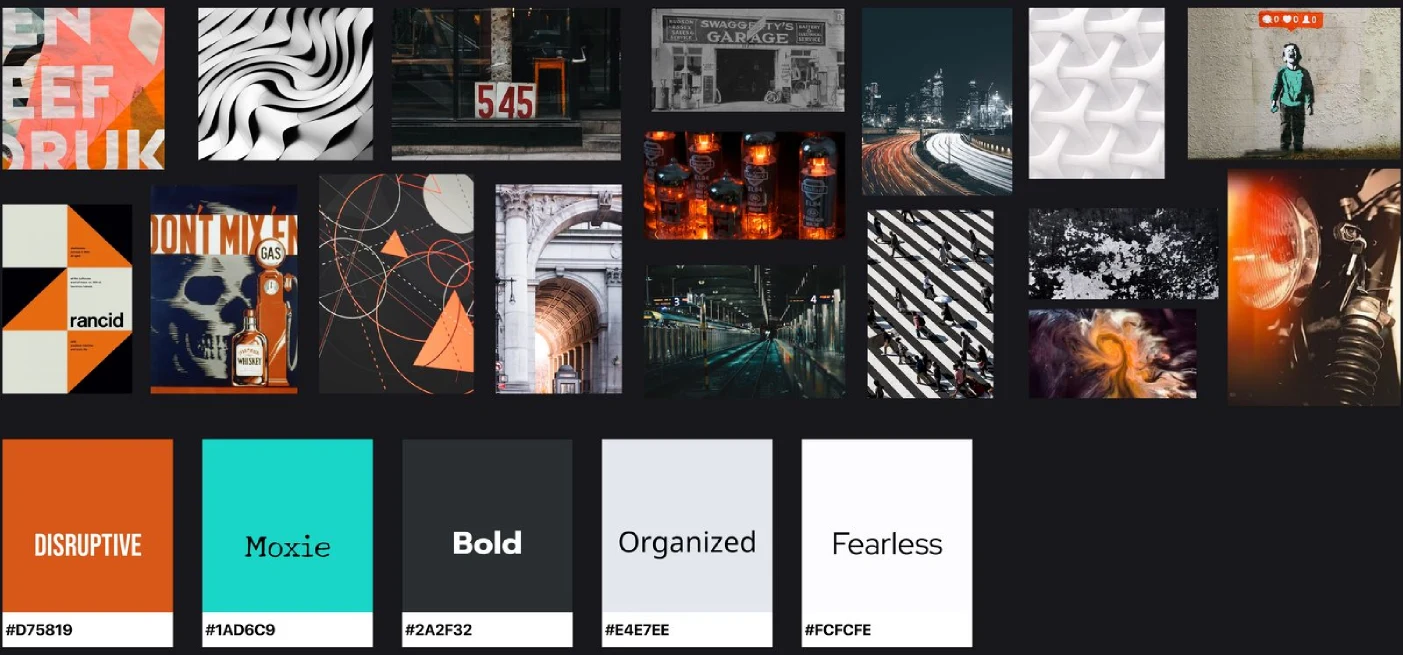
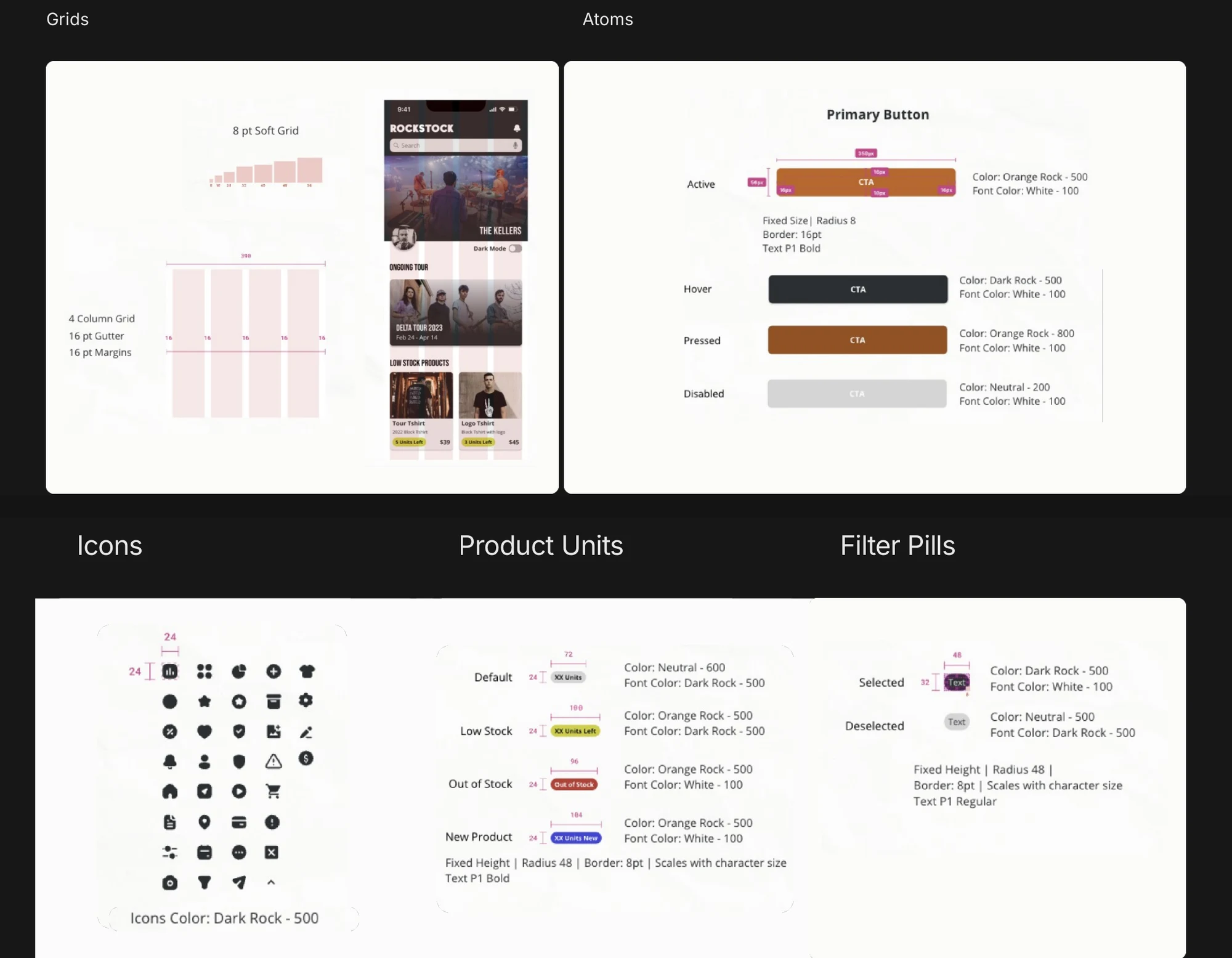
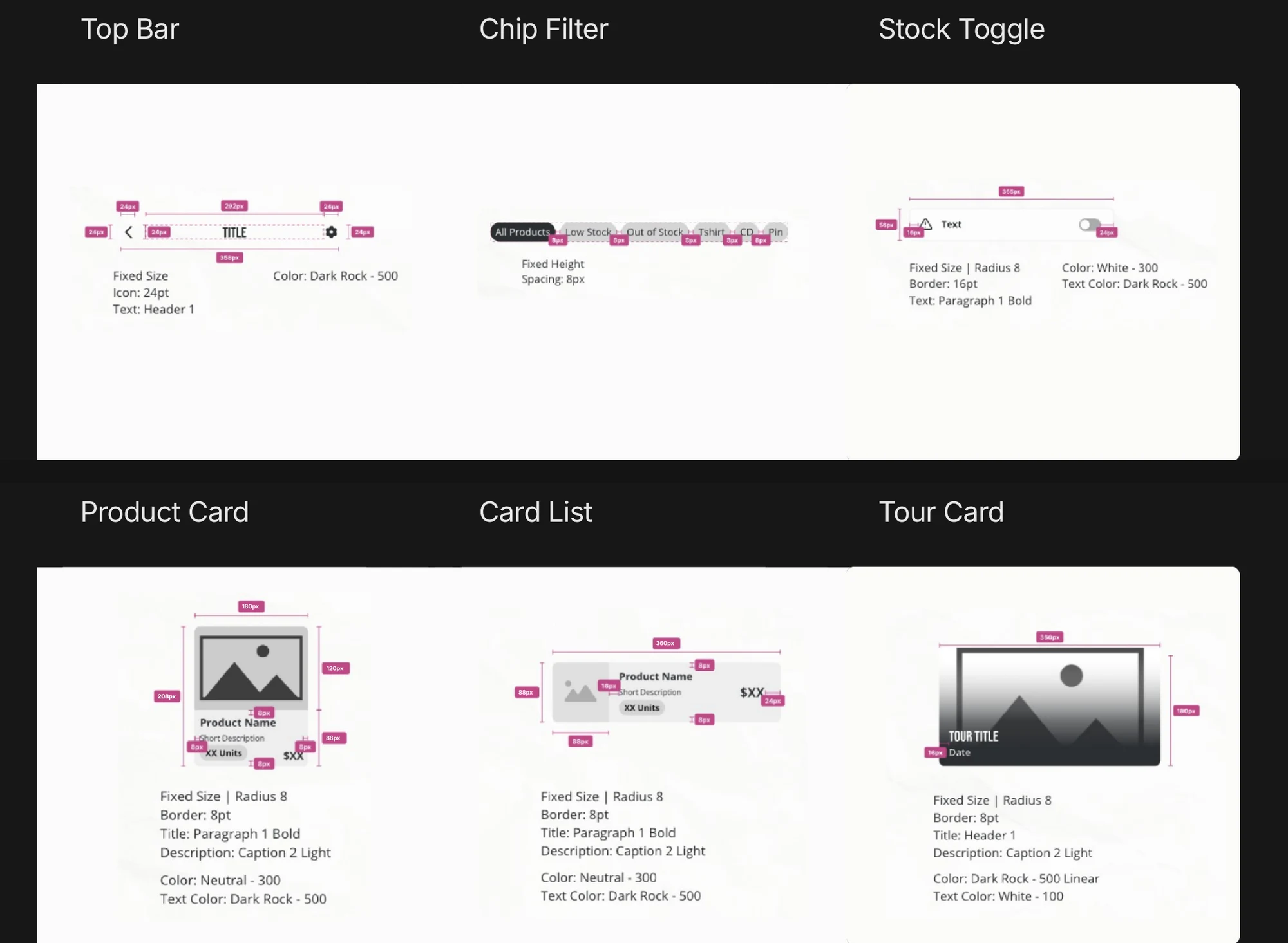
The brand had to feel like it belonged at a show and still read like a business tool. I built it from a mood board: Bebas Neue for loud, condensed headings, orange and teal over near-black, and a custom wordmark. Then I built the UI as an atomic library, and checked every colour pair for contrast so dark mode stays readable under stage lights.
9.1Mood board. Five words set the tone: disruptive, moxie, bold, organized, fearless.Image
9.2Type scale. One condensed face, five sizes.Image
9.3Palette with contrast ratios for black and white text.Image
The smallest pieces: an 8 pt grid, the primary button in every state, one icon set, stock badges and filter pills. Every colour and size is named, so nothing is decided twice.
Atoms combined into parts with one job each: the top bar, chip filters, the stock toggle, and product, list and tour cards.
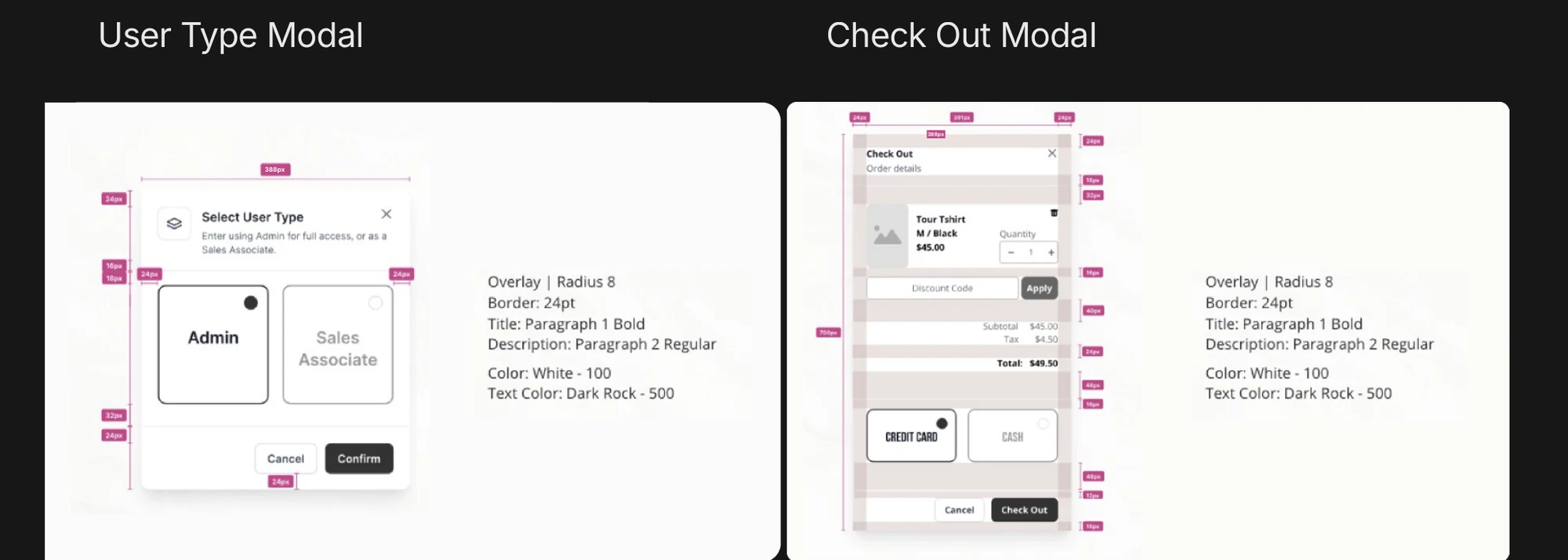
Bigger blocks that carry a whole task: picking who is using the app (admin or sales associate) and checking out a sale.
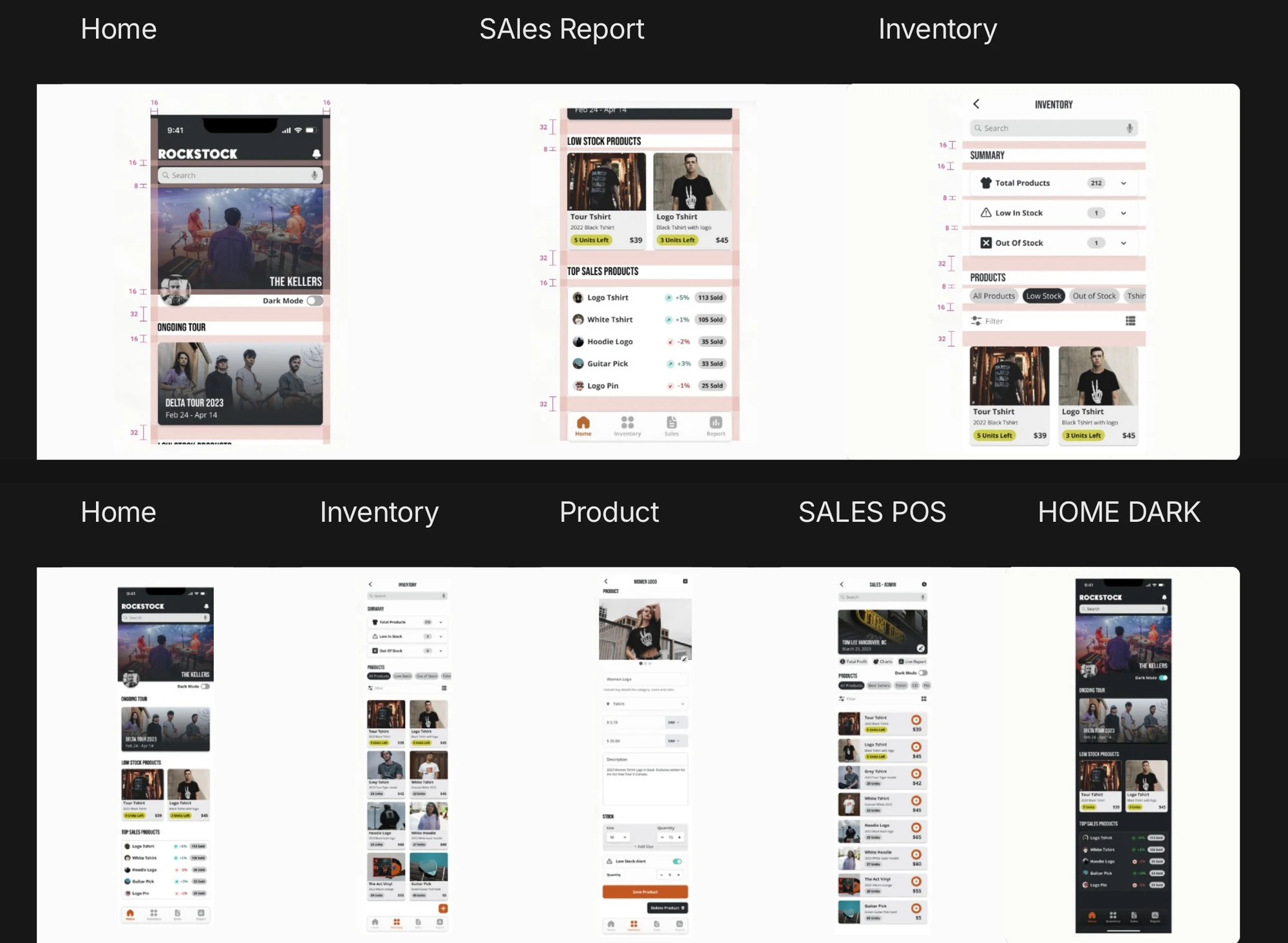
Templates for home, sales report and inventory, then the finished pages, including dark mode, built only from the parts above.
10 · The app
What it's built to change
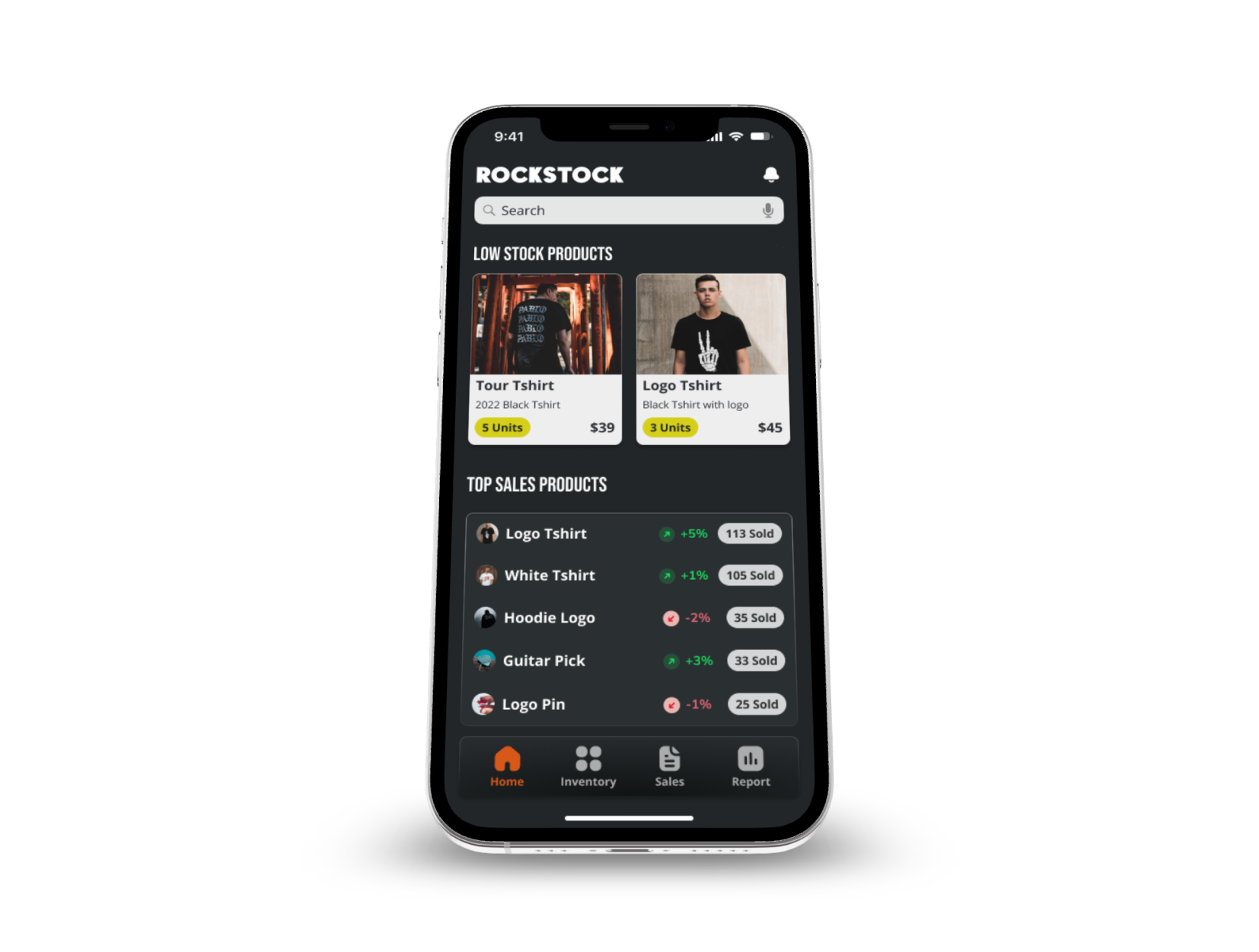
The high-fidelity app covers the full loop: register merch before the tour, watch stock during it, sell at the table and see what made money. It's a concept that was never launched, so these are the outcomes it was designed for, not ones I measured.
Faster setup
Product, sizes, cost and price on one page.
No sell-outs by surprise
Low-stock warnings on the home screen.
Money you can see
Live sales, top products and margins per item.
Safe hand-offs
A sales-only login for whoever runs the table.
Interactive prototype
Tap through the app: inventory, product setup and a sale.
10.1Inventory, list view, product setup and the admin sales screen.Image
10.2Home in dark mode: low stock, live sales and top sellers at a glance.Image
10.3The full set of screens, light and dark.Image
11 · Marketing website
A one-page site written like a set list
The website's job is one download. It talks like the audience (“Hey Rockstar”), opens with the problem, shows the app solving it, then closes on proof and the store links. On desktop the page leans into mood and story. On mobile it gets to the app faster, because that's where people decide.
Opener
A short impact line and a download button above the fold.
The song
Promo video and features: track sales, manage stock, keep more.
Encore
Gallery and testimonial slots, then the call to download.
11.1Desktop. Testimonials on the site are placeholder copy, not real reviews.Image
11.2Mobile, with the app up front.Image
12 · Reflection
What I'd do differently
I assumed bands could handle a retail-style process because it made the reports easy. Testing proved me wrong in one round. While the main flow was confusing, that was all people could talk about. Once it was fixed, the feedback turned to the details that make an app good.
My testers were design students, not touring musicians. Next time I'd test with the bands I interviewed, time each task, and check whether they'd actually pay for it before building a website to sell it.